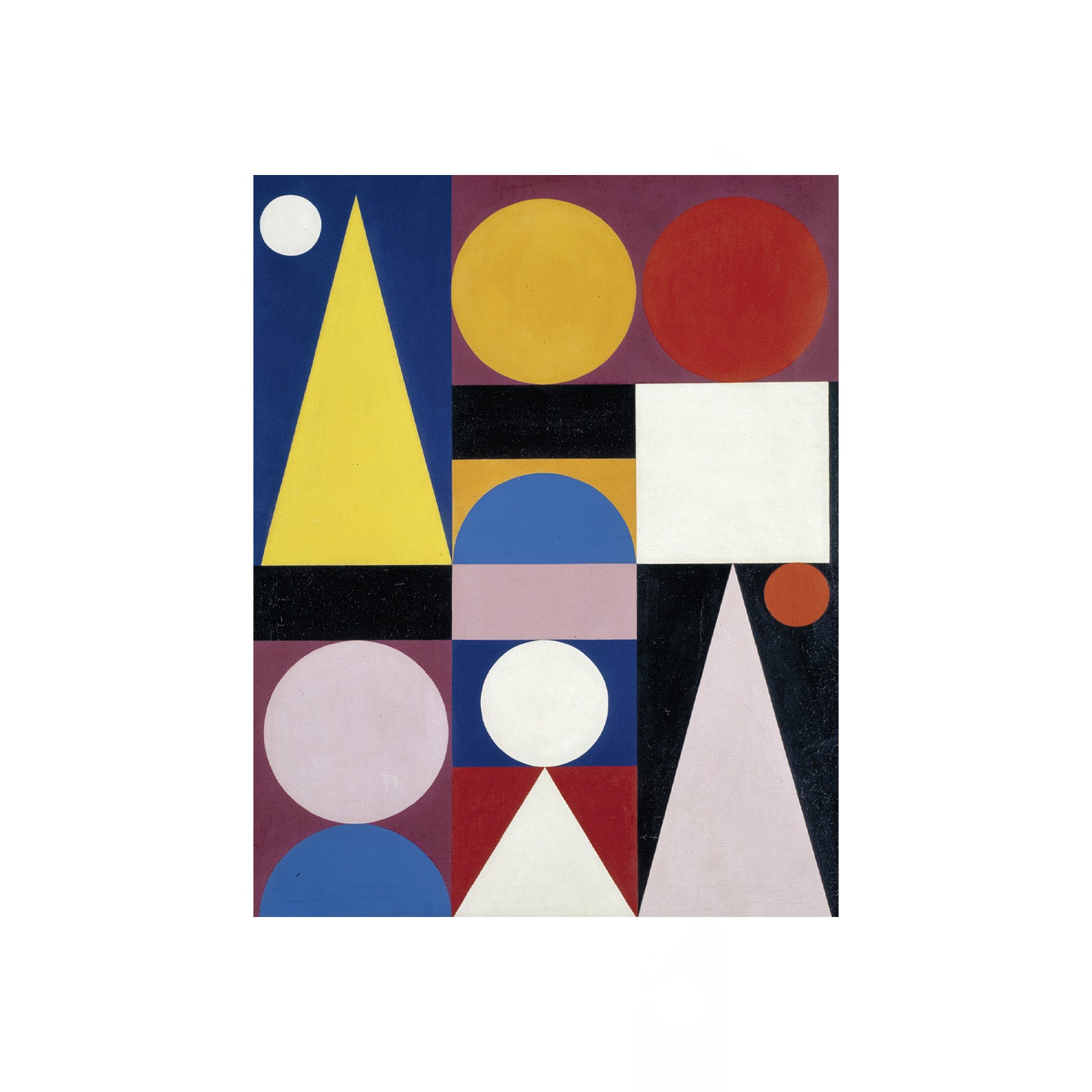
Postcard – Yellow (1946)
Choose options
Louisiana Postcard featuring the work Jaune - yellow (1946) by the French artist Auguste Herbin (1882-1960). Herbin was a constructivist who, in the 1930s, developed the style that became characteristic of his post-war paintings – such as Jaune here. The starting point is Herbin's own system, where simple geometric shapes and pure colors correspond to specific letters and tonal chords.
At Louisiana, constructivist art holds a special place. The museum's collection of constructivist art was significantly strengthened in 1986 with a generous donation from the American McCrory Collection. This gift followed in the years after Louisiana exhibited the McCrory collection in 1978 – the only known overview of constructivist art at that time.
Constructivism has its roots in Russia, where the avant-garde sought to renew artistic expression after the Russian Revolution. With their art, constructivists embraced the upheaval that manifested politically and socially. The artist, like the engineer and the scientist, was to build a new and better world.
Constructivists built their paintings from geometric forms, hoping thereby to create an art that could be understood by everyone, regardless of background. The expression was to be rational, objective, and utilitarian. Constructivists distance themselves from any depiction of the seen, the emotional, and the spontaneous, and instead create their own reality.
Parallel to the development of constructivism in Russia, experimentation with the constructivist idiom also took place in Europe. The Dutch art group De Stijl and the Bauhaus school in Germany found inspiration in the Russian constructivists.
Materials & Measurements
Recently viewed
